

Working alongside the Curatorial Department, Abby Mikalauskas joined The Rockwell Museum in September as the inaugural Mary Spurrier Fellow in Native American Art. Building on her thesis research which centers the material culture made by Dakȟóta community members, Abby spent her time at The Rockwell focusing primarily on beadwork and painted hides made by Great Plains communities.
Abby’s work provides essential context and research for The Rockwell’s collection of 472 historic Indigenous belongings. Through this effort, she has helped illuminate many obscured stories, supporting The Rockwell in their role as the objects’ current stewards. As the fellowship came to a close in early December, Abby shared some of her insights from her time as a fellow.

Did anything surprise you in your research?
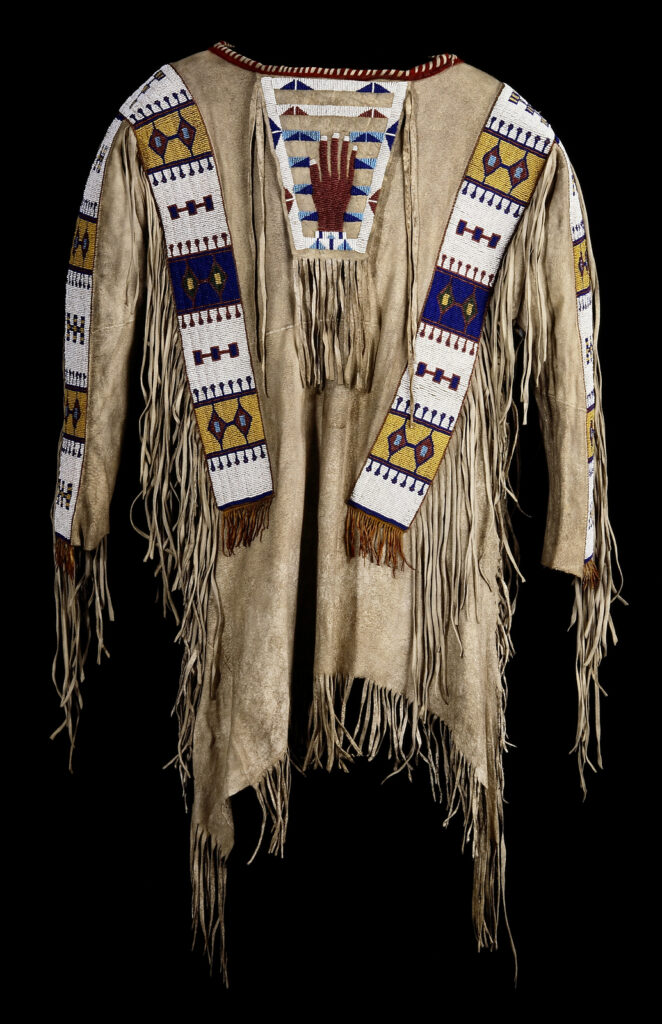
One of the biggest surprises—and excitements—from my time here actually came the first week of the fellowship. I had gone through the list of historic belongings and had chosen to start with a collection of items that were attributed to the Buffalo Bill Wild West Shows. Following what first caught my eye, I started with one of the two “Warrior Shirts” or “Chiefs Shirts” in this collection of Wild West material. Immediately, I recognized one of them as being made in the image of a Warrior Shirt worn by the Oglala Lakȟóta Chief, Maȟpíya Lúta (Red Cloud) and his son Jack Red Cloud, standing out to me because of the striking beaded hand on the chest panel.
Having studied this Warrior Shirt during one of my graduate classes at the University of Oklahoma, I was already familiar with the widely circulated photographs and portraits of both Maȟpíya Lúta and Jack Red Cloud wearing the original. Warrior Shirts, especially those worn by prominent leaders, have become emblematic of Great Plains warrior culture and, for many, still carry that significance today. Furthermore, Warrior Shirts are deeply personal, spiritual, and sacred, and up until the start of the fellowship I had never seen any two that were the same, which is why this immediately gained my attention. So, you could say this happy chance set off a positive chain reaction of research that was sustained throughout the whole fellowship.
What other highlights from your time here would you like to tell us about?
Aside from the depth of independent research I was able to do while at The Rockwell, which included close examination of accession records, hands-on engagement with the belongings, and other archival research, one of the most meaningful experiences I gained was the opportunity to meet and learn from the internationally renowned and respected Diné textile artist, D.Y. Begay.
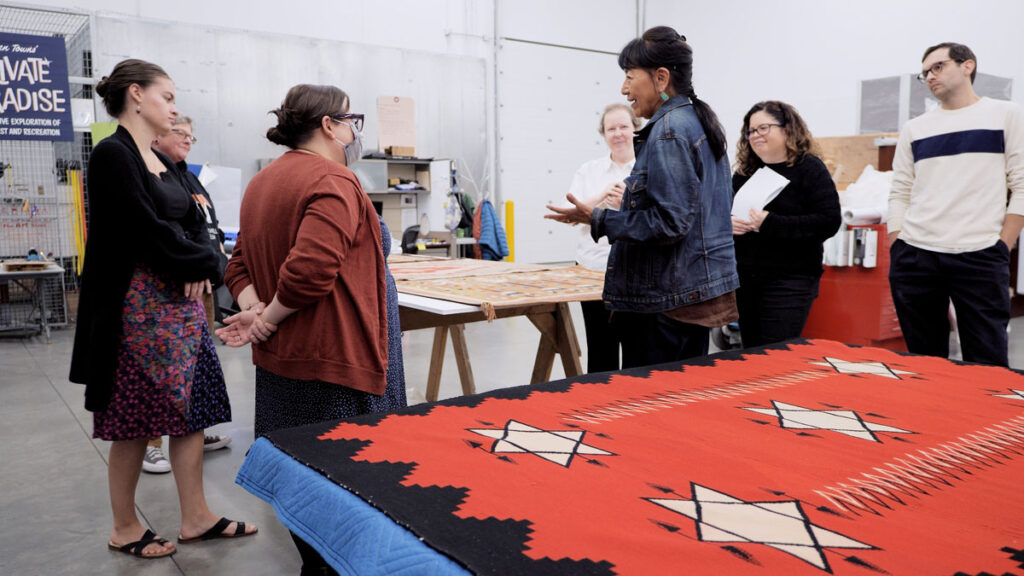
The Rockwell has commissioned Begay to create a tapestry for the collection, in honor of the Museum’s 50th anniversary. As part of her creative process, she visited Corning to explore the vistas and flora of the region, gathering inspiration for the work of art that will be unveiled later this year. I was familiar with D.Y. Begay’s work from my graduate classes, but I never imagined I would have the chance to meet her, let alone learn from her. As an art historian, it is easy to become bogged down in text, reading about artists or makers who have long since passed. That is why spending time in collections and speaking with living artists is such a privilege. Over the course of the morning, D.Y. was incredibly gracious with her knowledge as she guided the curatorial team through several historic weavings in The Rockwell’s collection. By the end of her visit, the curatorial team and I agreed that she had just given a masterclass on Diné textiles, one we are not likely to forget.
How do you hope this fellowship evolves in the future?
Given that I was the first in this fellowship at The Rockwell, I can only hope that it grows in a way that continues to support the historic belongings in the collection. As is the case for the majority of museums or universities that accumulated historic Indigenous belongings, the provenance records are sparse. I took this as an opportunity to explore every possible avenue of research I could come up with. That said, three months is a fairly short time for an endeavor this big, and I hope that the fellows to come will be able to build upon the foundation that I have started.
I would like to thank everyone here at The Rockwell, but especially the curatorial department who welcomed me as one of their own, and the generous support of Mary Spurrier, without whom this fellowship would not be possible. For future fellowship information, keep an eye out in the spring for the summer position opening!